
Larry Gerwin spent most of his adult life as a financial journalist and corporate crime investigator.
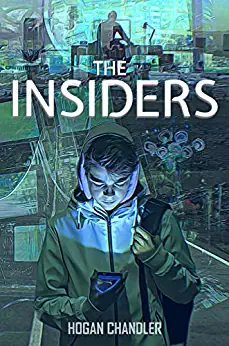
In the 1990s, he wrote a novel for young adults about high school student Zach Richards.He put the draft aside for decades and recently worked with his co-author Holly Hughes to add the finishing touches to his novel, which is out this month. insider By Hogan Chandler.
Hogan Chandler?
“Holly and I decided to put a single name on the cover as a pseudonym,” Gerwin said. corporate crime reporter in an interview last month. “The Ellery Queen novel was written by a team. Because he was a mutual friend, Bill Hogan, who introduced me to Holly.”
Why did you write this book?
“I wanted to capture the fun and thrill of investigation, the thrill of chasing and hunting. I also wanted to use it as an educational tool so that I could learn how to do it.”
“So I thought – let’s try to find a vehicle that allows me to accomplish those things. Our protagonist is a teenager. He’s in high school. I wanted to tell you something about someone, because that was one of my frustrations when I was a journalist.”
“It is often difficult to raise concerns about white-collar and corporate crime, just like violent crime and street crime. Money laundering and insider trading can sometimes seem abstract.”
“I started writing the book with a young student sitting in the classroom. He is looking at his watch. He wants to know the outcome of a case he worked on with his uncle. Victim is a victim of investment fraud.” And his uncle sued the scammer on behalf of the victims. I wrote a little bit about how it ruined my life.
“This was my way of reminding people of the serious consequences of fraud. It’s not a violent crime, but it can have a devastating effect on people.”
“Then we had to have a vehicle for students to get involved and do research. He stocks up on a game company that makes games, and he’s already a customer of it, and his uncle, who happens to be a stockbroker, and his mother teach him the basics about the market.”
Our hero, student Zach, who happens to be very bright and precocious, asks his mother and uncle – what makes stock prices go up and down? . If the company reports good news, or if people are optimistic about the company, the stock price tends to go up. He took this to heart and realized that the stocks he now owned were going up in value and there was no good news. As such, he immediately suspects possible insider trading. And that’s where the story begins. ”
“Adults who do this for a living and investigate financial crimes as prosecutors, federal agents, SEC enforcement attorneys, investigative journalists, etc. – many of them have children and their children are what they are. I don’t know if he makes a living doing
“And the teenage son or daughter of an SEC enforcement attorney or FBI agent who investigates financial crimes may have no idea what their parents do for a living. You might think it’s boring and nerdy that you’re not handcuffing people or kicking doors, but actually investigating this kind of crime might be a way of saying it’s kind of cool. Hmm.
Have you come across other young adult fiction that tackles issues of white-collar and corporate crime?
“A lot of people told me Holly, if you want to find a representative, try to find a representative for authors of similar books. So I did some research and found nothing like that. I didn’t.”
“There might be something out there and I’d appreciate it if someone could tell me about it. But the closest I could find was one young adult novel. It has very positive reviews.” It was the story of a teenage girl whose father was indicted for white collar crimes.The story was mostly about the shame and disgrace of her family and the trauma of her father being arrested and charged with a crime. But it’s not about investigating crimes.”
Why aren’t young people talking about this kind of corporate crime?
“People in society react more strongly to violent crime. People have an instinctive reaction to violent crime. There is no reaction, and there are things like second level crime like money laundering.”
“It’s hard to get people this angry about white-collar crime.”
“Years ago when I was working as an investigator, I was approached by an attorney at a large law firm. He was a former U.S. Attorney and he asked me – one of my clients Client wants to know if it is safe to travel to various places, and this is not a warrant in public records There was not.”
“I said – it might be possible, but I don’t know if it’s appropriate.”
“He was trying to calm me down and said, ‘Well, this is white-collar crime. And I was almost blown away by him. That he could have been a big client.’ And I said, Darcon Shield is white collar, and other horrible crimes fall into the category of white collar crime. are neglected.”
The key figure in this book is Uncle Ted. I sympathize with Uncle Ted. He is Zack’s uncle. He is a former US Attorney and now in private practice. Zack visits his uncle as he begins investigating insider trading.
Uncle Ted has a corporate crime library. And you write, “The largest number of Ted’s crime books related to white-collar crime – non-violent crimes committed by businessmen, corporations and banks.”
But you admit in our interview that corporate crime can become violent crime.
“I readily admit I made a mistake. I shouldn’t have. You are absolutely right. there is.”
“It’s just a mental habit. When we hear the word crime, we tend to think of a man catching someone in a dark alley and pointing a gun at them. When we think of crime, we think of street crime: murder and robbery. ”
“But take Madoff’s case, for example, where there was no physical violence involved. But if you ruin people’s lives, you drive them into poverty and you might end up committing suicide. Technically there was no physical violence involved, these people gave their money to the Ponzi scheme guys, they lost their money, and now they’re in the workhouse. I wasn’t involved at all, but that’s a terrifying outcome for anyone.”
This book is about this high school student, Zach, who is obsessed with tracking down insider trading cases. He conducts his own investigation and goes to the government to reveal information from his investigation that leads to the arrest of the trader.
“The Securities and Exchange Commission (SEC) is a major player in this story. I wanted to make sure the story was technically accurate. I am sending it to a friend who is a retired law enforcement attorney for the SEC and another friend who is a former assistant federal attorney who worked for FINRA, the so-called self-regulatory agency.”
“I sent it to a retired FBI agent, and I sent it to a former senior SEC official.
“I used Martha Stewart as an example of an insider trading case, and a friend of mine, a retired SEC enforcement attorney, reminded me that Martha Stewart was not charged with insider trading. She was indicted for lying to the government about insider trading, so I’m glad he caught that fiasco.”
“I asked – does this book capture the atmosphere within the committee? She said she worked there in the 1980s and was able to capture the atmosphere within the committee very well.”
“One of the things I tried to convey was the process of conducting an investigation, how it was actually done. I am an investigative journalist and a private investigator. I’ve never been a law enforcement criminal investigator, so there’s a lot I don’t know, but I know how to do an interview.”
“I conducted interrogations. I know how to do archival investigations. I have some knowledge of how criminal justice works.”
“The book is meant to be entertaining above all else, but it’s also a way of telling people how the investigation works. You can call it the investigator procedure: we talk about chronological charting, open source research, conducting interviews, link charts, and more.”
“Good research is doing reasoning and pattern recognition. These are things people like in Sherlock Holmes stories apart from the atmosphere of London 120 years ago.”
“Sherlock Holmes could make these inferences by seeing these little movements in a person’s dress and demeanor. Oh, you must have been in Afghanistan.”
“I will show you how skilled Zach is at finding anomalies. The walls of his office are covered with pictures of him with famous people, plaques, and diplomas. You notice something, but you don’t notice what should be there.”
“I tried to get young people into this world – this is how research is done. I enjoyed this book a lot and I hope it will be fun to read.”
[For the complete Interview with Larry Gurwin, see 36 Corporate Crime Reporter 33(12), September 5, 2022, print editon only.]
Comments
Post a Comment