
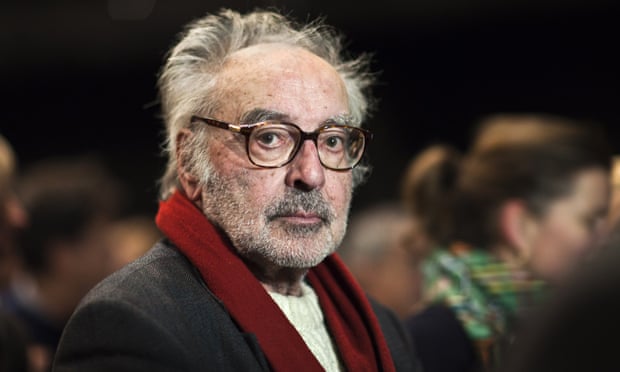
The last great modernist of the 20th century has died. Finally, Jean-Luc Godard became something of a charismatic but remote cult leader. It was as if Che Guevara had escaped an assassination and grew old in hiding in the Bolivian jungle.Godard, at first revered and adored as a hero, shrugged and yawned. He was influential in the sense that the French new wave rocked Hollywood and all filmmakers. His own sparse experimental procedures have today migrated to video art.
Godard exploded into world cinema in 1960 with À Bout de Souffle. This is the story of a young American girl in Paris played by François her Truffaut treatment, her Hollywood star Jean Seberg, and her devastating relationship with a sexy tough woman. A man on the run, played by Jean-Paul Belmondo. Godard ripped through the rulebook without much trouble reading: his wild digressions, quirky dialogue scenes, verité location work, non-narrative excursions, and “jump cuts” – intuitive and educated Inspired, semi-intentional wrong edits made by a non-author.

The 1960s was his glorious time when images and slogans could change the world. He was making movies with breathtaking fluency and speed. Godard was talkative, effortlessly fashionable, and the epitome of continental cool. A photograph of him lifting and inspecting a roll of film is pretty iconic, but the moody, unconvinced type thought he might look better if he took off his sunglasses. The painful impossibility of love was his theme, combined with cerebral discussions of politics. have a style
But my favorite Godard film of that era, and indeed my favorite Godard film of all time, is his Une Femme Mariée (1964), which rivals Agnès Varda’s Cléo 5 to 7. , is a mature but approachable masterpiece. A married woman who has an affair with a handsome actor. It’s intensely erotic and has a pure bohemian sheen to it. It’s an aside cine-essay, a cinephile wandering through Paris – where else? With a Warholian interest in magazine interviews, advertising iconography, and a fetishistic delight in underwear. Godard also uses subtitles on what Charlotte thinks as she eavesdrops on her two women talking about sex. This is his one of the sexiest and quirkiest movies ever made, and the self-respecting movie buff starring Brigitte Bardot Le Méprit or Contempt (1963). ) than

Often Godard films like Pierrot le Fou (1965) are inexplicably wild and largely incoherent, absorbing some of the controversial anarchy of the shoot itself. Yet there was always time for long intellectual discussions. Godard was always concerned with militarism and imperialism, the guilt and shame of France for the war, the horrifying shadow of the death camps, and of course Vietnam, which drove Godard into a conceptual thicket of radical Maoist and leftist 60. He was returning to the important issues of the age. He never fully appeared.
Unusually among filmmakers, he is a director, a theorist, a critic, Ma’a Penser, Experimentalists: Radicals who were the first filmmakers in the medium’s short history to seriously consider what cinema is and what it means. But inexplicably, Godard did not celebrate the thrilling early cinema as an art form, acting as if it were all over. The closing credits of The Weekend (1967) read, “End of Story – End of Movie.” In this he resembled the controversial literary critic George Steiner, who said that tragedy is dead, or that the German language is dead. Godard liked to provocatively and infuriatingly declare cinema dead. après moi, le deluge There was no stopping his own rampant productivity. Godard became a mysterious and infuriating magician who wanted to make a “movie,” not a movie, to release sound and image from his four bounding walls of the screen. He was decisively influenced by André Bazin, the great Cahier du Cinema critic, and began his career as a critic for that prestigious magazine, founder of the New Wave movement. intervene in life itself. The movie was a grip on reality.

The comparison is irresistible. Godard was one of the most critically acclaimed Robespierre in cinema. Or he was John Lennon. Paul McCartney was François Truffaut. Or maybe Godard was the Socrates of the media, and he believed that an unexamined film wasn’t worth having.
Godard’s brilliant talent for reading the zeitgeist never left him. His film Goodbye to Language, still as gnomically discursive and enigmatic as ever, is playfully enlivened with his 3D and considered by American critics to be his best film of 2014. had been Holidays: statelessness, alienation. Much of the film took place on cruise ships. What did Godard say about socialism, then he got his hands on history itself. The cruise ship Godard was filming was the infamous Costa Concordia, which capsized in a catastrophe in 2012. Many commentators argued that the tall design made this kind of pleasure craft top-heavy to accommodate an increasing number of paying customers. Godard’s camera lens is like an incredibly powerful telescope. It is as if he is watching man from a distant, perhaps another planet.

Many simply gave up on Godard or were embarrassed by the extravagant former hero-worship of the Sixties figure. However, his sexual politics began to appear troglodytic, and his loathing of Israel seemed at times to cross the line into anti-Semitism. A mature masterpiece was Histoire(s) du Cinéma (1988-1998), an epic eight-part video documentary project. This is his collage of texts of amazingly ambitious quotes, the quilt of clips in which Godard creates the personal landscape of the film. , a work of passionate cinephile love. Until now, I myself have not found anything in Godard that is truly inspiring. Yet there is something mystical and moving about the history of cinema. There is no one like Godard, now or ever, and his loss makes today a depressing day. A day to watch Une Femme Mariée and remember how exciting and sexy his films were.
Comments
Post a Comment