
Mesa County’s outdoor recreation industry outperforms the statewide economic impact figures, according to a long-requested report.
Nathan Perry, associate professor of economics at Colorado Mesa University, has compiled a report detailing the economic impact of the outdoor recreation industry in Mesa County. According to the report, Mesa County has a higher gross domestic product (GDP) for outdoor recreation than the state as a whole (4.8% in the county compared to 3.1% statewide), and outdoor recreation tourists outnumber ordinary tourists. have a greater economic impact on the county than .
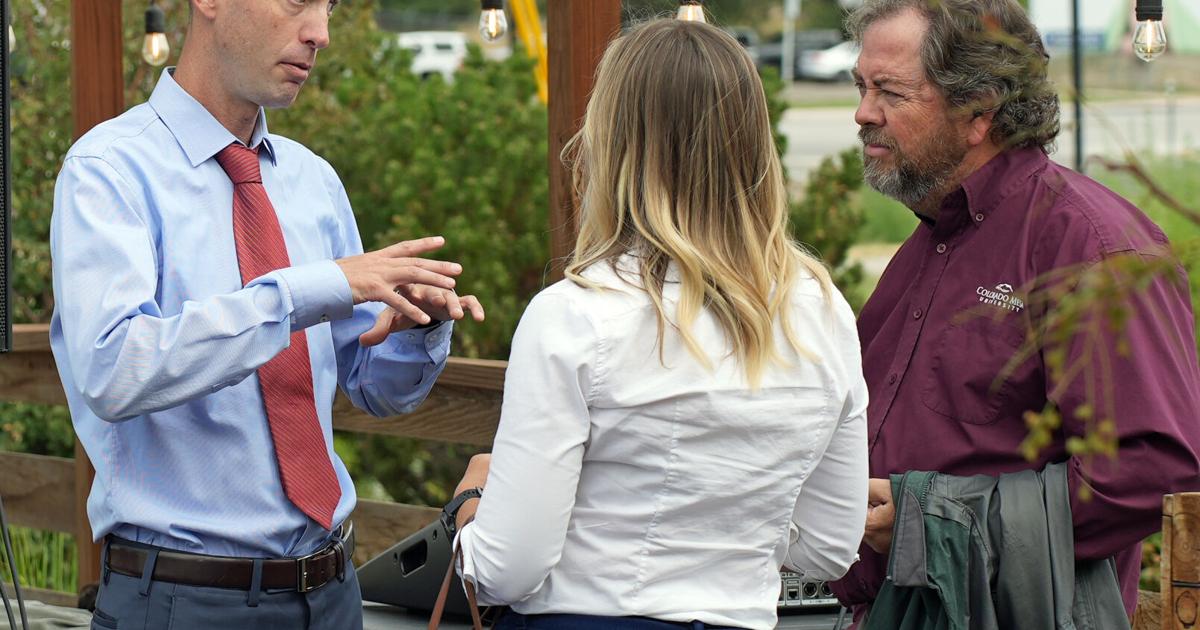
Perry presented his findings Wednesday at Base Camp Beer Works to local representatives of outdoor recreation businesses and nonprofits, educational and tourism partners, and economic development professionals.
“I’ve been asked to do this research for years, but I’ve been working on other projects and haven’t had time. “One of my motivations for doing this is that no one has estimated the economic impact of outdoor recreation in the county, so my academics are excited to try something new. I applied a methodology that I thought was powerful to get an estimate for an area that, to my knowledge, hadn’t actually been done.”
Perry used statewide data from the Bureau of Economic Analysis and comprehensive outdoor recreation plans statewide to inform his study. He also used the Grand Junction Economic Partnership to identify more than 150 of his local businesses involved in outdoor recreation and outdoor recreational tourism.
Perry’s basis of calculation featured four aspects of the income approach. He then used his IMPLAN economic software to determine the three economic effects. Direct effects (one or more production changes or expenditures made by a producer or consumer as a result of an activity or policy), indirect effects (purchases between firms in his chain of supply). local-occurring value derived from the purchase of the initial inputs of the industry) and induced effects (value derived from household expenditure on labor income after removing taxes, savings, and commuting income).
The report identifies five categories of outdoor recreation businesses. Trail/Road, Water Based, Winter, Wildlife Related, Other (RV Camping, Picnics, Shooting, Rock Climbing, Team or Individual Sports, Playground Activities, etc.). .
Companies involved in the survey provided by Perry identified trail/road activities as the most popular core activity, accounting for 50.9% of outdoor activities, water-based (18.2%), and other outdoor activities (16.4%). , followed by wildlife related (9.1%) and winter (5.5%) activities.
45 outdoor recreation businesses reported wages totaling $27,978,664. Applying these figures to the overall outdoor recreation business population, we estimate the gross wages of the outdoor recreation industry in Mesa County to be $93,262,213.
Four out of five categories of outdoor recreation businesses rely more on full-time employees than on part-time employees. 350 part-time employees compared to 250 or more full-time employees.
Perry has produced a table that presents the results of his research on the economic impact of outdoor recreation businesses.
The direct impact is 3,690 employees with a labor income of $98,466,896.
The direct GDP is $131,254,953 and the gross output value is $198,892,817. Adding indirect and induced figures brings the total to 2,501 employees. Labor Income of $131,925,902. $190,673,455 in GDP. The total production value is 318,783,484 dollars.
Add in businesses focused on outdoor recreational tourism and these numbers increase exponentially.
Direct figures rise to 7,620 employees. Labor Income of $200,550,181. $321,625,137 in GDP. Gross production is his $540,434,017.
Adding indirect and induced figures brings the total to 9,897 employees. Labor Income of $294,593,235. $484,474,065 in GDP. and $875,063,799.
Perry said Mesa County’s direct GDP of 4.8% (up to 7.2% when indirect and induced figures are taken into account) is not only due to the determination that 11% of Mesa County’s employees are working, but also the numbers. I said it was a promising result if I expected it to be the result of my calculations. outdoor recreation industry.
“I’m very happy with the results. I think it’s a very realistic number,” Perry said.
“We know Mesa County has more outdoor recreation than the Eastern Plains or other parts of Colorado. I think counties like the ones that have been hit will go higher. 4.8% is right about how far I think it will go.”
Perry explained the difference between GDP statistics and total production statistics, and gave examples that he often provides to introductory economics students at the beginning of each semester.
“Let’s say you want to calculate the GDP of cars,” says Perry.
“When you calculate GDP, you calculate the final sale of a car. If it sells for $15,000, that car counts $15,000. It’s counting dollars, $6,000 in plastic, and $15,000 sold by a retailer, but not counting all of them because that’s $25,000.
“Real GDP, the true value of output, is what the final good or service sells with all its value embedded. Gross production looks at a steel company and says, ‘Oh, $4,000 steel. Oh, $6,000 plastic, oh, the car company sold the car for $15,000.
“Total production does not follow GDP accounting. It represents how each company feels about it.”
Perry’s presentation kicked off Wednesday’s campfire conversation at Base Camp Beer Works, where a number of speakers spoke about outdoor recreation.
Speakers included Connor Hall, Director of the Colorado Outdoor Recreation Industry Office; Chandler Smith, Co-Founder of the Outside Events Cycling Series and member of the Grand Valley Outdoor Recreation Coalition; Vice President of Mountain Racing Products, Colorado Highland Mountain It was Scott Winans, a member of the Bike Trails Association (COPMOBA), Van Winkle Ranch. – Owner Jannie Vanwinkle, Rancho Duranzo Fruit Grower Gwen Cameron, Mesa County Executive Director of Child and Immigrant Services Nelly Garcia Olmos, Alvia Packcraft CEO and Co-Founder Mariana Ceballos, Josh Nierenberg, Co-Founder and Executive Chef of Bin 707 Food Bar and Taco Party Eureka! Jen Moore, executive his director of the McConnell Museum of Science, and Libby Collins, Colorado Westland Trust program manager.
.
Comments
Post a Comment